What is Pluribus about? We explore the true Pluribus meaning, interpreting the aliens as a metaphor for Divine Grace and the finale as a test of Free Will.
The first season of Pluribus has ended, and the audience is understandably electrified. The finale leaves us with a burning curiosity about Carol and Manousos’ next move: the two are now aligned, determined to save the world from the invaders to preserve their authentic selves. Naturally, questions about the true meaning of the show are flooding the internet: What do the virus and the alien invasion really represent? What is Pluribus about, after all?
The theories are endless. Most see Pluribus as an allegory for an intrusive entity aiming to erase our individuality. Some believe it is a message about the expansion of Artificial Intelligence and the necessary sacrifice of the individual for the “greater good.” Others argue the invader is a parable for Communism, or an enemy intent on erasing cultural traditions.
We have already discussed the theories regarding the virus and why certain individuals were immune. However, regarding the broader metaphor, there is a unique perspective that explains the series’ mechanics perfectly—a theory different from anything you will read elsewhere.
What if the coming of the Aliens is a metaphor for the coming of God to save humanity? And what if the “immune” individuals simply represent Human Free Will?
Let’s dive deep into this theory. But first, let’s start with the basics.
Pluribus Season 1 Ending Explained: Carol’s Journey and the Finale Twist

To understand the deeper meaning of Pluribus, we must first look at the literal events of the Season 1 finale. Throughout the first season, the alien “virus” acts as a silent invasion that is fundamentally rewriting the world. Carol and the few “immune” individuals remain a passive minority; while she longs to restore the world to its previous state, even within the immune circle, only she and Manousos are truly willing to fight this global transformation.
Carol’s arc passes through several distinct phases. Early on, she resists the Hive Mind with everything she has. However, after reaching a breaking point, the Hive distances itself from her for self-preservation. It is only after a month of total isolation that Carol begins to crave connection again, attempting to integrate with the “Others.”
The arrival of Manousos at the end of the season serves as a violent shock. He represents exactly what Carol was before her isolation—amplified to the extreme. Carol initially tries to temper his aggression, but realizing she cannot change him, she makes the drastic decision to leave him and spend a period of artificial happiness with Zosia.
The definitive turning point occurs when Carol learns the truth: the Hive Mind is using the eggs she had frozen years ago to synthesize a way to “convert” her without her explicit consent. Feeling existentially threatened, Carol returns to Manousos. As Zosia drops her home, a massive shipping container is lowered onto the street. In the final line of the season, Carol reveals it contains exactly what she requested: an atomic bomb.
Who are the Aliens in Pluribus? The “God” Theory
If we reflect on the arrival of the aliens, many of their characteristics are assimilable to the figure of God, especially in the Christian context.
First, consider the “virus.” It arrives on Earth not as a weapon, but through a message that needs to be decoded—much like the Word of God (Logos). The aliens love everyone equally; they want to bring about a happy, respectful survival for every living being. They cannot lie (absence of sin) and they do not try to deceive the “excluded” humans in any way. They live frugally, without waste, focusing only on what truly matters.
Most importantly, if humans show hatred or anger towards them, the aliens suffer physically. This mirrors the theological image of a Father wounded by his own children. They do not retaliate; they absorb the pain.
Earth is Hell (The Absence of God)
Before the virus arrives, the Earth depicted in Pluribus is a living hell. In theological vision, Hell is not a place of fire and damnation, but simply a world without God. The “free” world depicted in Pluribus before the alien arrival is a place of anxiety, violence, riots, and profound loneliness. Carol herself is medicated, anxious, and miserable.

It is a world where human instincts take over, making existence miserable and chaotic. Humans are on the brink of self-destruction. The “Salvation” arrives just in time, spreading rapidly and creating the closest thing to Heaven on Earth ever seen. The “converted” humans live in absolute peace, while the “immune” remain trapped in their own personal hells of loneliness and fear, solely because they have pushed God (the collective connection) away from their hearts.
From this perspective, Carol and Manousos are not fighting to preserve their freedom or to save the world. They are resisting to keep their lives exactly as they were before. They are fighting the entry of God into their world. Why? Because transformation is terrifying. It requires a leap that goes beyond the certainties we cling to. It requires faith in the world to come.
Unless they voluntarily choose to make that leap, their lives will remain the hell they know so well—a hell they have grown to love simply because they are afraid to let it go.
Free Will: The Key to Salvation
Do you see the parallel? The remaining humans are placed before God’s offer: a happy life and absolute peace in exchange for renouncing their selfish desires (the Ego).
When humans are in harmony with the collective (God), they are kind and respectful. When they move away from it, their destructive and aggressive nature emerges. Crucially, God (Pluribus) wants to include all humanity in His Kingdom, but He does not force this inclusion.
Free Will is the fundamental element of the process. Man must choose God of his own spontaneous will. He must want it. God offers the vision of eternal peace and the end of suffering, but the human must be the one to open the door. Respect for individual will is an integral part of the path to communion with God. This explains why the aliens stand still and wait, rather than invading by force.
The Stem Cell Twist Explained: Predestination vs. Free Will
There is a specific plot point in the finale that sparked significant controversy: the revelation regarding Carol’s eggs, frozen and preserved many years prior, which are now in the possession of the Collective. Zosia explains that they are working to produce the substance that will allow Carol to convert to the new world, even though Carol has not (yet) expressed her consent to do so.
For some viewers, this feels like a forced plot device, a manipulation by the aliens to infect Carol against her will. Yet, when Carol asks for confirmation that this will only happen with her explicit consent, Zosia replies, “That would be correct.”
Through the theological lens we are exploring, this element transforms into Divine Grace. God is offering the human Carol mercy and entry into His Kingdom, effectively facilitating the passage. It is akin to witnessing a miracle: even if Carol has not yet taken the necessary steps to enter the Kingdom of God, the universe is already moving in that direction to welcome her.
In theology, this touches upon the well-known paradox that allows Free Will and Predestination to coexist. Carol is still free to make her own choices, but in the perspective of a world regulated by God, her Destiny is already written. The choices she freely makes will simply be the steps that fulfill that path.
Adam, Eve, and the Atom Bomb
In this light, Carol and Manousos now represent the “Free Man” faced with the coming of God. They are offered the chance to voluntarily join the dimension of absolute happiness right before their eyes, but they must be able to see its beauty for themselves.
They need to change their perspective and abandon the instincts that lead to selfish desires—the temptation to place the entire world around their “Ego” rather than letting God wrap them in His message of peace.
The finale transforms Carol and Manousos into a modern Adam and Eve. They are in a terrestrial paradise, a place designed for eternal happiness, but they are free to make their own choices. The atomic bomb they hold in the driveway is the ultimate symbol of self-destruction. It is the “Forbidden Fruit” of violence. If they choose to use it, they will act recklessly, inexorably damaging the balance and condemning themselves to the ultimate solitude: the expulsion from Eden.
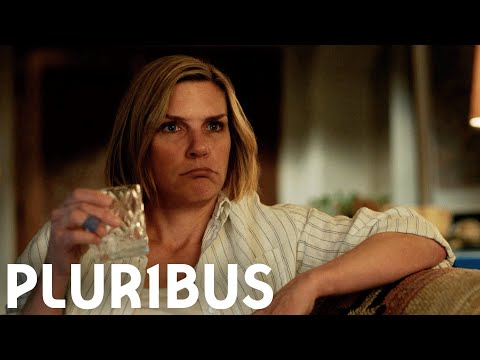
Season 2 will arrive soon, and we will be able to witness the free choices Carol and Manousos make in the face of this “alien” arrival on Earth. But now, we have a new lens through which to interpret the evolution of the story to come.
