
An in-depth analysis of Pluribus: we explain the true meaning of the virus, why Carol is immune, and the connection to Dostoevsky’s “The Grand Inquisitor.”
It is official: after Breaking Bad and Better Call Saul, Vince Gilligan has created another cult TV series for the modern generation. Pluribus is an atypical drama, far removed from the world of crime but once again masterfully effective at analyzing human psychology in the face of an enemy. This time, the threat is of a completely different nature: an alien virus, which arrived on Earth in the form of genetic code transmitted through radio waves, synthesized by humans, and immediately capable of infecting the entire population. It has transformed the planet into a hive-mind focused on surviving in the happiest, most respectful way possible.
“The entire planet,” that is, except for 12 people who, for reasons yet to be clarified, are immune to the virus. These 12 individuals represent the “old version” of the human being. Among them is Carol, an American woman who believes strongly in the value of identity and individualism, doing everything she can to revert the world to its former state.
This raises specific questions: Is the new human generation really a bad thing? Should it really be fought, or is it perhaps more correct to accept it and integrate? Is it right to give up one’s human nature—and in a sense, one’s freedom—in exchange for a peaceful and happy existence? This last theme is one that many have likened to the classic thesis exposed by Fyodor Dostoevsky in The Brothers Karamazov: the story of The Grand Inquisitor and the human capacity to endure their own freedom.
The themes at play in Pluribus are numerous, deep, and complex. In this Pluribus explained analysis, we will break them down in order.
Pluribus and Dostoevsky: The “Grand Inquisitor” Connection
Attentive fans have identified an extremely interesting connection in Pluribus to Dostoevsky’s “The Grand Inquisitor.” This story, presented in a chapter of The Brothers Karamazov, imagines Jesus returning to Earth during the Spanish Inquisition. Jesus is arrested, sentenced to death, and confronted by the “Grand Inquisitor,” who questions the correctness of the choices He made while alive, as described in the Gospels.

According to the Grand Inquisitor, sacrificing Jesus’ life to preserve human freedom and free will was a misguided choice because humanity is incapable of managing its own freedom. Jesus resisted the Devil’s temptations to gift humanity freedom, but the Inquisitor argues that man would be much happier if he simply surrendered the world’s relevant choices to the Devil (or, more generally, to an undisputed authority like the Church). By renouncing their freedom, humans could enjoy a “happiness organized by others,” exempting them from making complex decisions and relieving them of the moral burden of being free and righteous. For those who wish to delve deeper, we suggest reading The Brothers Karamazov or, if you prefer, the summary of “The Grand Inquisitor” on Wikipedia.
The parallel is indeed clear: the Hive Mind represents the Inquisitor, while Carol, a prisoner of this alien world, represents Jesus and the burden of freedom she insists on carrying. After the alien virus, the new human generation has managed to solve global conflicts and the inefficiencies of human existence. It has restored life in full respect of the planet and defeated loneliness. All at one single, enormous price: individuality.
Carol, in some ways the archetype of the egocentric human being, finds it unacceptable to deprive herself of her identity in the name of this surrogate form of collective happiness. This creates the series of questions Pluribus forces us to confront in every episode: Is our freedom—our autonomy—really too high a price to pay in exchange for global happiness and organized, respectful survival on our planet? If we accept the implied thesis that a free human will inevitably destroy the planet and themselves, is the alternative we observe in the series really so evil? Who is, truly, the villain in the world described in Pluribus?
Why is Carol Immune? The Psychology of Misery
At this point, the question arises naturally: beyond the supreme philosophical issues, why doesn’t Carol join this perspective of perfect happiness? And even before that, why isn’t she infected in the first place, like everyone else?
There is a theory regarding this that takes root in Carol’s very psychology: according to this view, Carol’s specific human nature prevents her from being happy.
Carol is the symbol of the typical Western individual, entirely focused on her own life and goals, and incapable of acquiring a global vision of things. As we watch the show, it feels natural to shift from identifying with Carol at the beginning (after all, “she is us” in the alien invasion dynamic we observe) to eventually distancing ourselves from her, recognizing typical traits of selfishness in her behavior. Carol is unwilling to give up anything of her idea of a “normal life,” even at the cost of demands with enormous impact, such as restocking an entire supermarket just for her. In her extreme vision, Carol wants to eliminate this form of global happiness to save human individuality, without even considering the beneficial effects of the new course.
The moment our narrow vision becomes our sole priority, it becomes inevitable that our existence poses a threat to the “other,” whether that be the world or our neighbor. At the same time, this makes the idea of happiness effectively impossible: we will always be surrounded by other individuals pursuing their personal idea of happiness, and the resulting conflict is inevitable, preventing any individual from finding peace. Individuality—and the freedom to live according to it—is, from this point of view, the condition opposite to happiness.
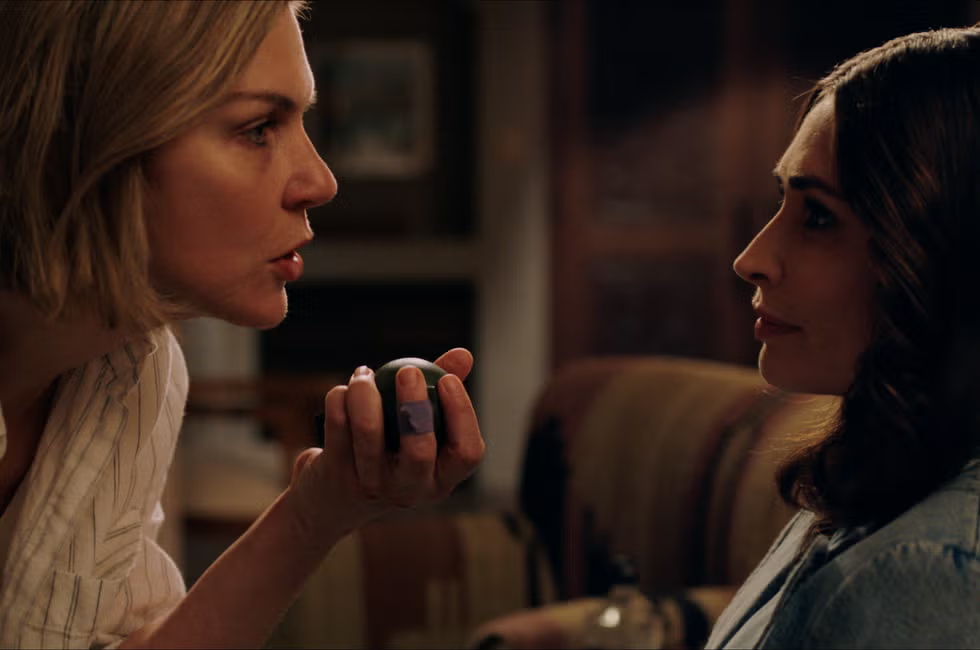
As a corollary to this theory, some have hypothesized that post-virus humanity intentionally rejects Carol as part of itself due to her innately noxious nature. Carol is characterized by constant anger and hate, which causes great suffering in the rest of humanity. According to some, this suffering makes integration irreconcilable, and this is why the virus excluded Carol from natural contagion.
The Alien Agenda: Cure or Weapon?
These reflections naturally lead us to question the very nature of the virus. Why did the aliens send this code to Earth? Is it a gift designed to save humanity and prevent its self-destruction, or is it meant to subjugate us, turning everyone into docile slaves of the collective mind?
These questions certainly make sense from a philosophical perspective. Reasoning from a universal viewpoint, and revisiting the concepts of Dostoevsky’s Grand Inquisitor, individualistic man needs to be saved from the burden of his own freedom because he is woefully incapable of managing it. The submission of the individual in the name of collective happiness would seem to be the only possible solution to save both man and the planet. If this is true, there may be a higher design (perhaps divine?) in the arrival of the alien virus on Earth: a form of forced evolution of the human being towards a subsequent form that reasons as a species within a planetary ecosystem, prioritizing respectful survival and collective happiness.
Carol poses some of these questions directly to Zosia, the form through which the Hive Mind interacts with her. The answers she receives are far from exhaustive: on several occasions, Zosia explains that the behavior of the Hive Mind is actually the only way their nature is capable of living. Therefore, there would be no preliminary plan guiding the invasion, but rather a biological imperative. As the final stage of the evolution of living beings, the Hive Mind has developed the perfect mechanics for survival on a planet, and is now incapable of living any other way.
Conclusion
The most compelling way to analyze Pluribus is through the lens of this existential conflict: the battle between individual freedom (which brings chaos and self-destruction) and a controlled, efficient happiness (which inevitably requires a form of slavery and the surrender of free will).
The viewer is called upon to answer this universal dilemma. The moment you find your own explanation, you will automatically understand whether you stand with Carol or with the Hive Mind.
In the meantime, we will continue watching the series, which has already been planned for a second season. We strongly doubt that the plot of Pluribus will provide a definitive answer to these dilemmas. However, Carol and the other 11 immune survivors will be forced to make clear decisions for their future within this new world.
And you, whose side are you on?
