
📌 In This Deep Dive
Netflix’s The Final Problem adapts Arturo Pérez-Reverte’s novel into a homage to Sir Arthur Conan Doyle, connecting characters Basil and Elisa directly to classic Sherlock Holmes mythology. By reframing the central island murders around the legacy of Irene Adler, the adaptation builds an intricate bridge between 19th-century detective fiction and modern mystery television. This breakdown explores The Final Problem ending explained, unpacking the subtle book departures and the deeper significance of the finale’s final name swap.
At a certain point while watching The Final Problem on Netflix, it really wasn’t clear anymore where the characters ended and the actors began. The final episode starts off staying cleverly vague, never explicitly telling us where those events are actually taking place. We see the main characters still talking about the exact same story from the first three episodes, but from a different location, inside parallel situations, all while the characters gradually turn into actors and the scenes feel like they’re about to be shot completely from scratch.
Yeah, The Final Problem is a complex watch, one of those shows that really calls for a detailed explanation. And alongside that breakdown, there’s a whole collection of background details that make the story even more fascinating, starting with the book it’s adapted from and the legacy of Sherlock Holmes that hangs over the entire plot from start to finish. Basically, this is the definitive guide to the series, so get comfortable.
What happened in the ending episode of The Final Problem?
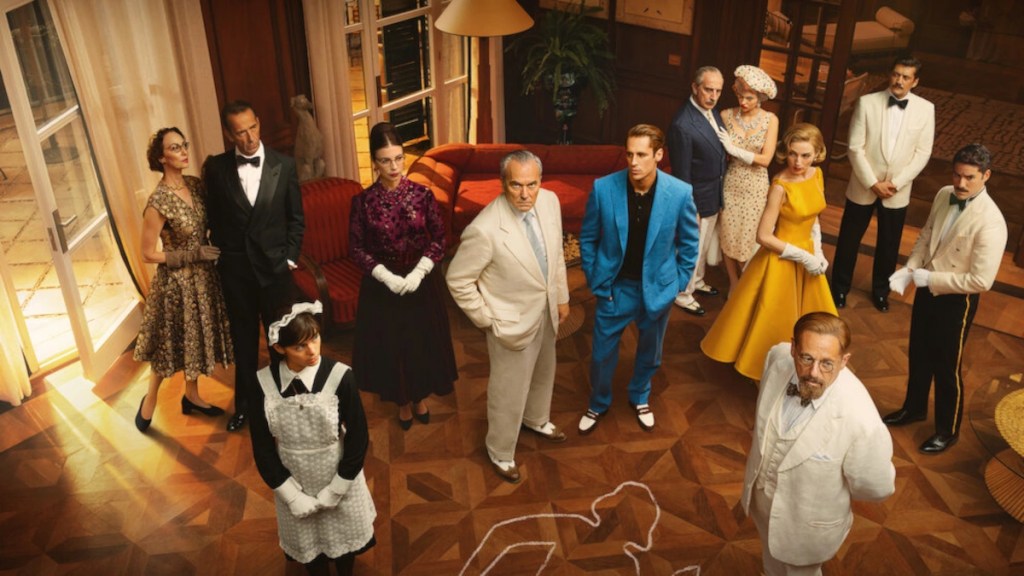
For the first three episodes, the story is pretty straightforward: Benjamin Basil, a famous actor known for playing Sherlock Holmes in the past, gets stuck in a small hotel on the island of Santa Águeda alongside a handful of other people, while a storm cuts off all connections and communications with the rest of the world for days. During those days, three murders take place, and Basil tries to solve the mystery and figure out who the killer is. But he doesn’t succeed: once the storm passes, the police arrive and fail to find enough evidence to arrest anyone. The investigation remains open, and the characters leave the island.
The fourth episode takes place a few months later. The characters are shooting a movie based on the events that went down on Santa Águeda a while back, with Basil as the lead actor, Francisco Foxá as the writer, and Fonseca as the producer. Amusingly, in the version written by Foxá, the killer turns out to be Basil, which was the exact suspicion Foxá had voiced on the island. That’s why the final episode opens with a scene where Basil acts out the part of the killer murdering Klemmer. As Basil himself points out, the writing is pretty rough around the edges and leaves plenty of room for improvement.

Right as the final episode opens, Basil has summoned Adela Figueroa to the studio set, the wealthy lady for whom Elisa Mander, the first victim on the island, worked. As Basil explains, he has finally cracked the final problem, and he now knows who the killer is.
That final problem was the classic locked-room mystery, a timeless trope of detective literature that Arthur Conan Doyle himself explored with Sherlock Holmes in The Adventure of the Speckled Band. A dead person inside a locked room with no other way out: how do you explain it?
In the case of the initial murder, Basil lays out the explanation right there on the movie set. The victim was killed, her shawl was spread out on the floor with a chair placed on top of it, and the door was locked. The killer then pulled the shawl from underneath the door from the outside, creating the illusion of a door jammed from the inside. Following that murder, two more bodies would pile up: Dr. Seruya, the doctor who examined the corpse, and Klemmer, a German guest staying at the hotel.
Basil brings Adela to the studio to give her the full breakdown of the crime: the killer is actually her. Except she isn’t Adela at all, but Elisa, and the woman killed on the island was the real Adela.
The Final Problem Explained: Adela Figueroa & Elisa Mander, Who Is the Killer and Who Is the Victim?
Adela Figueroa is a wealthy woman, while Elisa Mander is her friend who follows her everywhere as a personal assistant. Both women are single, spend a lot of time together, and physically, they look remarkably alike. As we find out in the final episode of The Final Problem, Adela frequently asked Elisa to swap identities. That way, Adela could indulge in activities considered socially unacceptable for a woman of her high standing, while the humble Elisa got to enjoy the perks of high society. But over time, that arrangement bred a deep resentment in Elisa, who felt increasingly used.
That resentment became the motive that pushed Elisa to murder Adela and take her place. That night, the two had swapped identities again, and Elisa followed Adela, killed her, and staged the locked-room crime scene. Everyone at the hotel believed the dead woman was the assistant, Elisa, but that wasn’t the case at all. Basil is able to prove this months later thanks to records sent by the British Royal Air Force. The deceased woman was actually Adela, who had no strawberry allergy whatsoever, despite the corpse having traces of strawberry on her lips. The survivor, on the other hand, is Elisa, who RAF documents confirm is allergic. Indeed, she doesn’t even touch the cake at the restaurant with Basil.
Elisa kills Seruya, who had figured everything out and was trying to blackmail her, and then takes out Klemmer, the former SS officer who had ordered her husband’s death during World War II years earlier. The whole thing was premeditated, mapped out by Elisa the moment the opportunity presented itself. And while she went around eliminating those men, she was simultaneously throwing down a challenge to Basil, who represented yet another man to get revenge on. Decades earlier, when Elisa was a young woman trying to make it as an actress, Basil had a brief affair with her and then walked away, forgetting about her almost immediately.
So the series wraps up on a bitter note. Elisa tries to kill Basil but fails, and after she reveals their shared past, the actor changes his mind about what to do. Basil chooses not to call the police, letting Elisa get away. In their final exchange, the series throws in one more shift that leaves viewers scratching their heads: she addresses him as “Mr. Holmes,” and he replies to her as “Mrs. Adler.”
At this point, it’s time to look at the books that inspired the series in the first place.
The Final Problem: The Book and the Connection to Sherlock Holmes
The book that inspired the Netflix series is the 2023 novel The Final Problem by Spanish author Arturo Pérez-Reverte. The Netflix show follows the plot of the book fairly closely, with just a couple of changes when it comes to locations (the novel is set on a small Greek island, and the ending takes place at Elisa’s villa on Lake Garda) and character names. Pérez-Reverte’s novel is obviously a tribute to Sherlock Holmes, but also to Basil Rathbone, the English actor who famously played the detective in the 1940s movies.

At the same time, The Final Problem is also the title of a classic Arthur Conan Doyle short story. Published in 1893, it follows a completely different plot and was intended to be the piece that ended Sherlock Holmes’ life for good. It’s also the story where Conan Doyle introduces Professor Moriarty for the very first time, the character who would go down in history as the detective’s ultimate arch-nemesis (we talked about him recently for the release of Young Sherlock on Amazon Prime). The story ends with Watson convinced that both Holmes and Moriarty plummeted to their deaths following a struggle at the Reichenbach Falls in Switzerland. Conan Doyle would eventually bring Holmes back to life in later works, and Moriarty would be referenced multiple times down the road. That’s exactly why the references to Moriarty run so deep throughout the Netflix series.
“Mrs. Adler,” on the other hand, refers to Irene Adler, the female lead of another story in the Sherlock Holmes canon, A Scandal in Bohemia. Irene Adler is the only woman who ever manages to evade justice and outwit Sherlock Holmes. In the original story, Holmes develops a deep respect for her, coming to refer to her simply as “the woman” and asking to keep her photograph as a keepsake of the only female figure capable of defeating him intellectually.
In the finale of The Final Problem, Basil closes by saying, “So it wasn’t Moriarty who was at work on the island. It was Irene Adler.” It’s his way of admitting that the person who outsmarted his investigative brilliance wasn’t a male rival, but a woman—exactly as it happened to the original Sherlock Holmes in A Scandal in Bohemia. Elisa proves she knows that story well, and the two bring things full circle by addressing each other with those names as they say goodbye. In doing so, the series ends with an invisible thread that starts in Conan Doyle’s original books and arrives on Netflix in 2026, by way of a Spanish novel published a few years earlier. And as readers and viewers, we can only be thankful.
Frequently Asked Questions
Yes. The series is based on Arturo Pérez-Reverte’s 2023 bestselling Spanish novel El problema final. The show retains the book’s central island premise, locked-room murder setup, and literary references while adapting the pacing and visual atmosphere for television.
The killer is Adela Figueroa—who is actually Elisa Mander in disguise. Elisa faked her own murder in the locked room on the island by using a shawl pulled beneath the door to lock it from the outside, leaving the body of the real Adela behind. She then murdered Dr. Seruya and Herr Klemmer to prevent her identity from being exposed.
Elisa staged her death by killing Adela, placing her body on the floor, stowing a shawl beneath the door under a heavy chair, locking the door from the outside, and then pulling the shawl tight from the hallway to jam the latch, creating the illusion that the room was locked from within.
Basil addresses her as “Mrs. Adler” in reference to Irene Adler, the central female character from Arthur Conan Doyle’s Sherlock Holmes story A Scandal in Bohemia. In Holmes lore, Irene Adler is the only woman who ever outsmarted Sherlock Holmes. By calling Elisa “Mrs. Adler,” Basil acknowledges that she defeated his investigative brilliance, bringing the story full circle.
