Discover the incredible true story of the 1990s UK Customs team behind the Netflix series ‘Legends‘, the real life of Curtis Warren that inspired Hakan and Carter in the show, and how a billion-dollar drug seizure turned into a judicial disaster.
There are series that faithfully mirror the true stories from which they draw inspiration. On Netflix, we have seen several of these in recent times, such as the story of the Silesian lead poisoning from Lead Children or the power of bureaucracy against Nazism in The Swedish Connection. Then there are others, those compelled to introduce additional cinematic elements to render the narrative even more captivating on screen.
Legends, the Netflix limited series centered on an undercover unit of the British Customs and Excise in the 1990s, falls into this latter category: discovering the true story that inspired it allows us to open an unexpected window into one of the most sensational episodes in the war on drugs to unfold in the United Kingdom during those years.

Indeed, that colossal drug seizure witnessed at the end of Legends is inspired by a true story from 1992, yet it carries fascinating differences, through which one can trace how the series weaves real-life facts into its on-screen characters. And while the real figure behind Guy is indeed Guy Stanton—author of the book The Betrayer: How An Undercover Unit Infiltrated The Global Drug Trade—the most intriguing task is to uncover who lurks behind the character of Declan Carter, the Liverpool drug lord, and that massive narcotics shipment that takes center stage in the series’ second half.
This is a story that others have not told you, yet it has left hidden traces within the historical records still available today. And it is a story that did not conclude with the happy ending we witnessed on screen.
The Legends of the Netflix series: the real team of British undercover customs officers
The four British customs employees we encounter in Legends are inspired by a genuine undercover team established at the dawn of the 1990s to combat a drug trade that had become a profound social plague in those years. The war openly declared by Margaret Thatcher was a historical reality, leading to the formation of the so-called Beta Projects: a clandestine group of volunteers from within the customs ranks who, after only the most rudimentary training, transformed into undercover agents infiltrating the gangs trafficking drugs across British soil.
For years, the existence of this group was shrouded in deep secrecy, but with the release of Legends, there is an evident and explicit desire to finally shed light on such heroic acts in a definitive manner. Among the four protagonists seen on Netflix, one was specifically Guy Stanton, who in 2022 chose to reveal the intricacies of his operation in the book The Betrayer; meanwhile, the other three were constructed around figures who truly existed within the ranks of the Beta Projects.
Even the media-saturated tragedy that sparked Margaret Thatcher’s political resolve is rooted in a true story: in the historical record, the teenager who dies of an overdose—entering the collective imagination through Legends—is inspired by Olivia Channon, the daughter of Cabinet Minister Paul Channon, who died of an overdose in 1986. It was an event that resonated deeply within society, convincing the political class that the time had come to stem the tide of the drug problem in the United Kingdom.
As series creator Neil Forsyth has stated, virtually every character in the series is inspired by real individuals, though a direct one-to-one link does not exist for everyone. Consequently, it is not always possible to draw a straight line between a fictional persona and its real-life counterpart. Yet, if we look more closely at the narrative of the heroin shipment from Pakistan to the UK, orchestrated by Hakan and Carter, passing through Germany to the port of Felixstowe… well, there is a sensational real-life case that resembles it unequivocally, despite a few shifts in geographical details.
The real drug lord of Liverpool: Curtis Warren and the sensational drug seizure of 1992
In Legends, Netflix introduces us to a young and astute Liverpool drug lord named Declan Carter; within the true history of those years, there is little doubt as to the criminal who inspired this character: it could be none other than Curtis Warren, one of the most prolific European drug traffickers of all time.
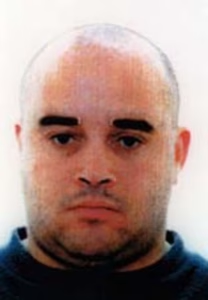
Warren was renowned for his unique ability to marry a visceral “street-level” intuition—forged amidst the petty crimes of his youth—with a strategic capacity to coordinate the transport, logistics, and distribution of staggering quantities of narcotics. He spent much of his life moving in and out of prison, yet even from within a cell, he managed to orchestrate and sustain his criminal empires. He even secured a place on the Sunday Times Rich List, appearing officially as a property magnate. It was no coincidence that he was known by the moniker “Cocky.”
The ambitious scheme to coordinate international drug trafficking through British ports is, in fact, drawn from a feat Warren actually performed: in 1991, he allied himself with car dealer Brian Charrington, and together they traveled to Venezuela, where they struck a deal with the Cali cartel. The parallels with the series’ characters are stark: Carter and Hakan are both shadows of Warren; while Legends focuses on heroin, the true story revolved around cocaine, and Charrington played the part of the “logistics expert” that the series assigns to Guy.
How did that shipment fare in the annals of history? In truth, the first test was a success: as recounted in this article from the Liverpool Echo, the vessel left Venezuela in December 1991, carrying approximately 500 kilograms of cocaine hidden inside lead ingots. The intelligence possessed by Curtis Warren was impenetrable: he knew the exact length of the drill bits utilized by British Customs, and he ensured the cocaine was stowed within a cavity deep enough to remain untouched by their inspections.
The startling revelation was that when the ship docked in the United Kingdom in January 1992—at the very port of Felixstowe seen in Legends—Customs had already been informed about the narcotics within. Yet, despite this forewarning, the search yielded nothing, and the drugs poured into the British market.
How had Customs obtained this tip? It was Charrington himself who had informed them, acting as a secret source. But the parallel between Charrington and Guy’s role in Legends diverges here: in reality, Charrington would be arrested for drug trafficking several years later.
What followed that cocaine shipment in the real story, however, is even more remarkable than the fictions of Legends…
The Customs investigations, the arrest of Curtis Warren, and the trial of 1993
Following the collapse of that initial inspection, Customs eventually secured the evidence proving that the shipment did indeed contain narcotics, using the intelligence gathered to intercept the subsequent load and arrest Warren, Charrington, and the other criminals involved. This chapter of the story is chronicled in this BBC audio documentary and involves further tips, striking parallels with the series Legends, and a profoundly bitter conclusion.
After the first transport was successfully completed, Warren ordered his right-hand man, Geoffrey “Snowy” Lowery, to dispose of the ingots and erase all evidence of their existence. Yet, Snowy chose to resell those ingots to a local scrap dealer named Paul Grimes, to whom he revealed how they had been utilized. Paul Grimes, however, had no intention of ignoring what he had learned: his son Jason had died of an overdose shortly before, and this family tragedy had convinced him to become a police informant. Here, one finds a clear parallel: Eddie, Carter’s right-hand man in Legends, fuses elements of both Snowy and Grimes from the true story that unfolded in 1992.
Through the information obtained from Grimes and new leads from Charrington, Customs prepared for the next shipment, which was even more substantial: 900 kg of cocaine arrived at the port of Felixstowe, but this time, the customs agents were waiting. It stood as the largest drug seizure in British history up to that point, leading to the arrest of Curtis Warren, Brian Charrington, and 26 other criminals involved in the operation.
The trial commenced in late 1992 but quickly descended into a veritable judicial inferno. The primary complication arose because Customs had also arrested Charrington, who was, in fact, an informant; consequently, the police exerted immense pressure to have the evidence against him declared inadmissible, even involving Parliament. The judge was ultimately compelled to exclude the evidence from the trial to acquit Charrington, a move that significantly weakened the charges against Curtis Warren, who was defended by a formidable legal team.
In the end, due to this peculiar entanglement regarding Charrington’s role as an informant, the judge declared Curtis Warren not guilty for lack of evidence. Legend tells that Warren, before leaving the courtroom, approached one of the customs officers and whispered: “Now I’m going to go and spend the £87 million I made from the first shipment, and there isn’t a thing any of you can do about it.”
To call him “Cocky” would be an understatement…

The ending of Legends and its parallel with the true story
In the finale of the Netflix series Legends, we see the criminals behind bars and the undercover team feeling the relief of a job well done. However, the ending leaves a bitter taste: the politicians take all the credit, while the heroes who sacrificed months of their lives stay in the shadows, returning to their ordinary jobs without any real recognition.
But at least in the series, the bad guys go to prison. The true story behind Legends has a much more frustrating ending: following the legal disaster of the 1993 trial, the criminals were actually found not guilty, even though almost everyone was certain they were responsible.
Curtis Warren did eventually go to prison a few years later, in 1996, after Dutch police raided his villa and found over two tons of drugs—a mix of cocaine, heroin, cannabis resin, and ecstasy. Since then, Warren has spent most of his life behind bars, with short moments of freedom cut short by new arrests. For years, however, he continued to run his drug network in the UK directly from his cell.
So, on one hand, Legends tries to bring light back to a story that deserved to be told and to heroes who deserved to be celebrated. At the same time, the true history of the hunt for Curtis Warren and the drug wars of the 90s isn’t a simple story of success: it’s a story where a record-breaking seizure was eventually ruined by the very system that was supposed to protect it. And it serves as a reminder that reality is often made of gray areas that are hard to understand, and the fight against crime rarely ends with a clean victory that stops illegal activity for good.
Frequently Asked Questions: Separating Fact from Fiction in Netflix’s Legends
Yes. While the series introduces cinematic elements and changes some names, it is deeply rooted in the real-life operations of the Beta Projects, a secret undercover unit formed by HM Customs and Excise in the early 1990s. The series draws heavily from the memoirs of former agent Guy Stanton, titled The Betrayer.
The character of Declan Carter is inspired by Curtis “Cocky” Warren, the most notorious drug lord in Liverpool’s history. Much like Carter, Warren was a strategic mastermind who rose from street-level crime to become a billionaire trafficker with direct links to international cartels, eventually appearing on the Sunday Times Rich List.
Yes. In 1992, British Customs agents seized a massive shipment of narcotics at Felixstowe docks. While the series depicts it as heroin, the real-life haul consisted of approximately 900kg of high-purity cocaine hidden inside lead ingots—the largest seizure of its kind at the time.
The character of Guy is based on Guy Stanton, a real-life customs officer who spent years infiltrating global drug syndicates. Stanton’s real-world experiences with the psychological toll of undercover work and the technical details of the “Legend” identities provided the foundation for the series.
In one of the most frustrating chapters of British legal history, the real-life trial of Curtis Warren and his associates collapsed in 1993. Due to the revelation that a key associate was a police informant, the evidence was deemed inadmissible. Unlike the ending of the series, the real “Carter” (Warren) walked free from Newcastle Crown Court, allegedly mocking the officers as he left.
Yes. The character of the informant (Paul Grimes in real life) was driven by a personal tragedy. His son, Jason Grimes, died of a drug overdose at 21. This loss motivated the elder Grimes to provide the crucial tips that led to the Felixstowe seizure, seeking a form of justice the law could not initially provide.
