Finally, the answer to the mysterious 2026 Target commercial song: meet Teddi Gold, the artist behind the track that many believed was AI-generated.
There is a particular kind of frustration unique to the digital age: hearing a fragment of a song during a commercial break, becoming instantly captivated by its rhythm, only to discover that the collective intelligence of the internet seems to have no idea what it is. Spasmodic searches begin; the digital legions of Reddit mobilize, scouring every corner of the web, yet nothing surfaces for months. It is almost as if brands themselves intend to breathe life into an inexplicable mystery surrounding their advertising, allowing the silence to fuel a different kind of virality.
The Target 2026 commercial has triggered exactly this kind of “short circuit”: featuring a hyper-kinetic pop song drenched in neon hues and a rhythm that feels almost mathematically perfect, the spot has driven thousands of viewers to reach for their smartphones. Yet, they have been met with a wall of silence: no results on Shazam, no matches on Spotify, and no trace in any lyric database.
This void of information fueled an increasingly persistent theory across social media: is the song the product of Artificial Intelligence? Many became convinced that Target, in its drive for extreme optimization, had generated a synthetic “jingle”—an algorithm specifically programmed to trigger dopamine receptors without the need for a human author.
But the truth, as is often the case, is far more compelling. It reveals a piece of human craftsmanship hidden behind the curtain of the music industry—a mystery that, as we often do, we at Auralcrave are uncovering before anyone else.
The 2026 Target Commercial Song: Not an Algorithm, but Teddi Gold
In recent months, two specific advertisements have become modern obsessions for the television audience. Both are set within a futuristic, essentialist environment where customers move rapidly through aisles, entranced by the colors and forms of the products on display.
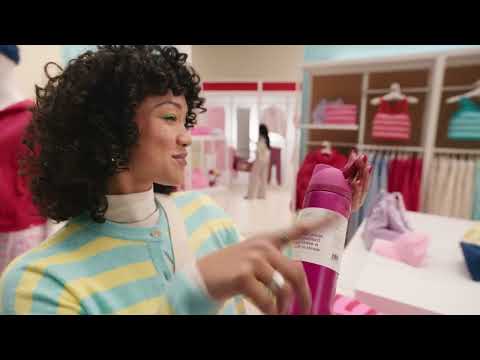
The song possesses an irresistible pulse and a melody so “catchy” that it feels precision-engineered to lodge itself in the mind long after the screen goes dark. For months, the song’s identity remained a phantom. Today, however, the veil is lifted thanks to industry credits. The 2026 Target commercial song that has been driving the audience to distraction was not generated by an AI: it is an unreleased creation by the young indie-pop artist Teddi Gold, known for her vibrant and unconventional style.
Confirmation comes directly from the portfolio of Low Profile, one of New York’s most influential music licensing agencies, which curated the track’s placement for the Target campaign. The commercial is listed among the recent “syncs” in their professional portfolio here and was also featured in a celebratory Instagram post in March.
But what exactly is a “Sync”? In industry parlance, Synchronization refers to the license required to pair a musical composition with a moving image. When we see “Sync” next to the name of Teddi Gold, we are witnessing the birth certificate of a collaboration: a track—in this case, an unreleased one—that has been “synchronized” with the brand’s aesthetic to become its sonic soul.
Who is Teddi Gold: The Caribbean Soul behind the Technicolor Pop
Teddi Gold is not the product of a conventional upbringing within the metropolitan confines of the United States. Her creative identity was forged during a childhood spent in the Caribbean, a context that injected her musical aesthetic with an organic vitality and a sun-drenched radiance that synthesizers alone could never replicate. One need only listen to a track like Bossa Nova Baby to capture her peculiar ability to touch diverse styles and sounds, uniting them under a modern, experimental lens.

This background, far removed from the frenetic rhythms of modern life, allows us to decipher the almost physical warmth that emerges from her work. Her music is a mosaic where the ancestral rhythms of the islands meet the experimental drive of Los Angeles—a character that has now defined the Target 2026 campaign. Teddi Gold operates on frequencies she describes as “Technicolor,” a concept that blends the precision of contemporary pop with the spontaneity of her origins. You can find more of Teddi Gold’s music on Spotify.
In the spot, the sonic impact does not arise from a digital equation, but from an exquisitely human capacity to capture the energy of a real experience—composed of light, space, and movement—and transform it into a universal motif. It is that “island touch” that makes the difference, transforming a simple jingle into a breathing work of art.
In an era where we are bombarded by synthetic content, discovering that an independent artist’s hand is behind that irresistible rhythm is, in truth, a relief. The song in the Target commercial is so infectious that it seemed like a futuristic product designed solely to “hook” us; instead, it is the original composition of a young, profoundly talented artist. And now, the public is clamoring for an official musical release.
Teddi, are you listening?
