Explore the dark history between Beate Lønn and Tom Waaler in Jo Nesbø’s books and the Netflix series ‘Detective Hole’: from the psychological violation in ‘Nemesis’ to her final act of liberation, discover what really happened between them.
The definitive screen adaptation of Detective Harry Hole and the literary world of Jo Nesbø has finally arrived. The Netflix series Detective Hole honors the dark allure and visceral narratives of one of modern thriller literature’s most iconic figures, masterfully laying bare both his singular brilliance and his inner demons.
The series captures the disturbing essence of Nesbø’s prose with surgical precision. With the author himself serving as creator and showrunner, the atmosphere is distilled from the criminal underbelly of his Oslo—a city that, in Nesbø’s universe, functions as a sort of Gotham City drowning in its own shadows. The score, meticulously crafted by Nick Cave and Warren Ellis, provides the essential haunting resonance required for the project’s success.
While specifically adapted from The Devil’s Star, the fifth installment of the saga, Detective Hole weaves in narrative threads from the preceding novels. This layering adds a profound density to every character, sparking a deep-seated curiosity among viewers. Among those introduced to this world through the screen, one of the most compelling mysteries surrounds the palpable psychological burden carried by Beate Lønn, the police force’s “special recognizer” who assists Harry in his investigation: it is evident that a grave transgression exists between her and the corrupt Captain Tom Waaler, yet these past events are never explicitly detailed. It is only natural, then, to look toward Jo Nesbø’s original text for answers.

From the repulsive echoes of the past to the final, liberating act that unfolds just beyond our sight in the Detective Hole finale, we explore Beate’s traumatic history within the books and why her unique talents render the wound even more profound.
The Body Remembers: Beate’s Nausea at the Sight of Tom in Detective Hole
The series presents this dynamic as a traumatic event relegated to the past, yet one whose effects remain strikingly present. From the moment Detective Hole introduces us to Beate Lønn—and her extraordinary talent for effortlessly recognizing thousands of human faces—we are immediately confronted with the weight of her trauma. It takes only a single instance of being in close proximity to Tom Waaler for her body to react instinctively, forcing her to seek refuge in a bathroom, gripped by nausea and panic.
What exactly happened between Beate and Tom in Detective Hole and within the Jo Nesbø novels upon which the series is based? When Ellen asks how she already knew him, Beate dismisses the query with haste, claiming he was once her instructor at the police academy. Yet, this is transparently an evasive answer; throughout the remainder of the series, we are led to imagine that something violent and abusive occurred in their shared past.
The answer, naturally, lies within the pages of the books. But it is a reality far more subtle—and perhaps more insidious—than one might initially perceive.
The Shadows of the Past: The Confrontation Between Beate and Tom in Nemesis
Beate Lønn makes her entrance into Jo Nesbø’s universe in Nemesis (2002), the novel that immediately precedes The Devil’s Star. In this chapter of the saga, Beate offers her singular talents to the police force, becoming one of Harry Hole’s most trusted and synergistic partners. Even then, the friction between Hole and Tom Waaler was already a raw nerve: it is in Nemesis that Waaler’s arms trafficking operation is first glimpsed, and he is already fully committed to dismantling Harry’s career before his own crimes can be unearthed.
It is toward the conclusion of Nemesis that Tom Waaler’s abusive nature toward Beate reaches its zenith. As the narrative careens toward its final revelations, Waaler appears at Beate’s apartment. Initially, it presents as a domestic violation cloaked in civility: Tom brings a bottle of wine, seats himself in her living room, and together they listen to Prince’s When Doves Cry, commenting on the beauty of the composition. The reference to Waaler’s shadow life arrives with subtle malice: “The Prince” is, in fact, his codename within the arms trade he orchestrates in Oslo.
Waaler is there for a reason: he demands to know Harry’s whereabouts. When Beate remains defensive, Tom’s posture shifts. His attitude becomes invasive, violating an essential boundary in Beate’s psychological fortifications: the memory of her deceased father.
Beate’s father was a policeman who died in the line of duty years prior. As he sits in her sanctuary, Tom Waaler intentionally profanes that memory, reconstructing the man’s final moments aloud to strip Beate of every defense. In Nesbø’s description, Waaler’s voice seems to hollow out the room, leaving Beate lost in a blurred, agonizing fog.
The Violation of Memory and the Weight of the Unspoken
Tom Waaler operates from a position of absolute power asymmetry, acting not merely as a predator but as Beate’s superior officer. He possesses a specific objective and is willing to shatter his victim’s psyche to achieve it. In a moment of lucidity, Beate recognizes the abusive nature of the encounter and reacts, demanding that Tom leave her home.
Jo Nesbø terminates the scene with a jarring abruptness, leaving the aftermath to the realm of the unspoken. From the pages of Nemesis, we know that Waaler is overtaken by a surge of explosive rage; he seizes Beate by the shoulders and forces her into the very chair he had occupied moments before. He speaks no further, allowing his physical dominance to trigger an uncontrolled terror within her. His objective at that point is to transform into terror itself—and from the cold satisfaction visible on his face just a few pages later, we know he succeeded.
Beate and Tom at the ending of Detective Hole
Much of what truly transpired between Beate and Tom in Jo Nesbø’s novels remains outside the narrated events, and therein lies the horror. The shadow of the unknown leaves us in a state of lingering apprehension, tapping into those primal fears that reside within us all. In the Netflix series, Nesbø chooses to allude even more explicitly to a history of physical abuse: in the final scenes of Detective Hole, we witness Tom violently pulling Beate’s hair, whispering, “I thought you liked it.”
In both the books and the past hinted at in the series, we lack absolute certainty regarding what truly happened that night between them. Yet, it is vital to emphasize that the psychological violence Tom exerted—violating the sacred memory of her deceased father—is more than enough to forge a profound trauma. Beate is rendered utterly vulnerable in the presence of a man who has already proven his ability to manipulate her sensations and fears at will.
The Burden of a Singular Talent and the Final Liberation
There is another dimension to consider: Beate is a “super-recognizer.” Her memory is naturally calibrated to retain the minutiae of faces and events with a persistence and precision far beyond the norm. We can imagine that every micro-expression on Tom’s face from that night in her apartment is indelibly etched into her mind. Encountering that face daily in the office serves as an unshakeable reminder of the invasive power Waaler can unleash at any moment.
From this perspective, Beate’s extraordinary gift becomes an inescapable prison. While the human psyche often utilizes the process of forgetting to accelerate the healing of trauma, this is biologically impossible for Beate due to her unique mental architecture. she is condemned to live forever with the awareness that there is a person capable of dismantling her stability whenever he chooses.
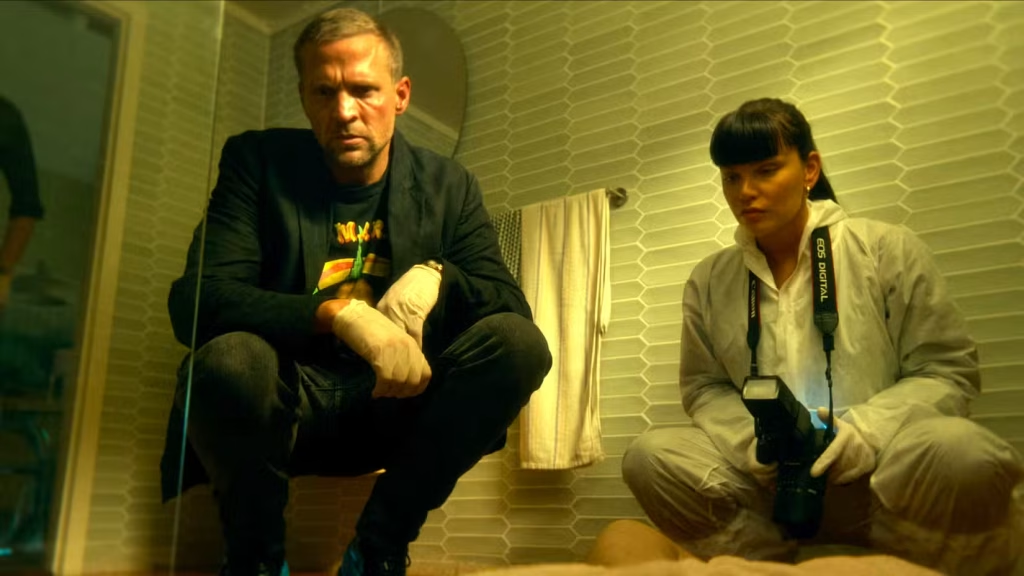
This context allows us to grasp the visceral sense of liberation Beate must have experienced in the finale of Detective Hole when she finds herself alone with Tom’s corpse. Here, too, the resolution of the trauma occurs off-screen, but this time we can vividly imagine the scene: we see Beate raising a dagger with both hands above her head. Scenes later, the medical examiners performing the autopsy discover strange chest wounds—inflicted post-mortem, but with a ferocity and relentless obsession that speak volumes.
It is through this lens that Jo Nesbø and the series pull us into a tide of anxiety, rage, and helplessness, denying our eyes a definitive closure. In both the literary and cinematic realms, we are left expecting that something else will soon emerge; the door to a potential second season is already wide open.
