A movie without dialogue, the complete absence of human language: analyzing Flow and its meaning.
As the director himself, Gints Zilbalodis, explained, Flow (Straume in Latvian) was born from a “flow of fantasy.” Indeed, this animated film presents itself as a free expression of images, with every detail immersed in the flow that drives the narrative. On a technical level, the editing unfolds as a seamless succession of scenes, while the story develops within a unified space-time continuum, where vastly different species of flora and fauna coexist in the same habitat, and time—without anyone to measure it—becomes a continuous stream of moments.
Set in a post-apocalyptic era, Flow begins with a natural disaster that has likely already occurred and is bound to happen again: a devastating flood that terrifies our protagonist, a solitary cat who must learn, alongside other animals, to adapt and face constant dangers. They are all in the same boat—literally. Meanwhile, humanity, which had continued building its Tower of Babel, has already been wiped out, a victim of its own arrogance.
Humankind’s endless challenges to nature have ultimately led to its downfall, leaving behind only traces of its now-ruined creations. The most striking aspect is the absence of dialogue, of human language. The fact that the animals do not speak is not a deficiency but rather a silent declaration of belonging; it is a touch of realism that sets Flow apart, steering clear (thankfully!) from the style of giants like Disney and DreamWorks, which have grown tiresome in their repetitive portrayal of a fully anthropomorphized universe.
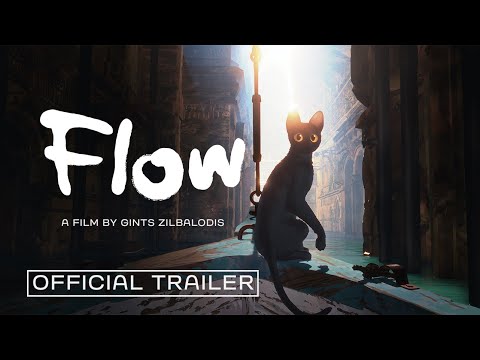
In its meaning, the movie Flow seems to tell us that in a world of environmental exploitation, wars, and human alienation, there is little reason for peace of mind. We live in a society without fixed points, where everything flows and nothing—or almost nothing—achieves solidity and stability. Bauman, the theorist of liquid modernity, foresaw this long before post-humanism engulfed us in an underwater realm where both reality and consciousness risk drifting away. The real question is how we will navigate the water—an element of transformation par excellence—how we will follow and be shaped by the flow of change, the same flow in which our frightened yet courageous little cat finds itself entangled.
But how is reality depicted in Flow? It lacks cultural ethos and the symbols that humans once strived to interpret. Or rather, it lacks the interpreter itself—the poet who adorned things with additional meanings. Everything exists as it appears, nameless; the dialectic between consciousness and object has been severed in favor of an immediate existence, lived without the filter of reason.
The survivors, then, speak without speaking, communicating only through their respective vocal sounds. What they share is an essential, necessary language, used solely as a survival tool. Free from the burden of words—which, among humans, have also been a source of chaos and destruction—a cat, a dog, a capybara, a secretary bird, and a lemur, all vastly different from one another, can form a community. However, their unity is a fragile and improbable “all for one, one for all.” Flow, in fact, avoids becoming a naive bedtime story, instead showing how difficult this endeavor is, given the natural opportunism that governs the behavior of most animals.
The true meaning of the movie Flow confronts the audience with the (difficult) mission that humankind in Flow has failed: the survival of living beings cannot exist without cooperation and respect for others, including nature, the one great home in which we all live as temporary tenants. What is needed, then, is a deeper empathy to solidify our increasingly liquefied relationships, while also recognizing that delicate environmental balances must be preserved, not controlled.
One must ask: how can a world built by and for humans survive its own disappearance, given that humanity represents the pinnacle of organic evolution? Setting aside the rhetoric that paints us merely as cosmic destroyers, perhaps we should question—if we are capable—how significant a film is in which humans no longer have a say, yet remain the only ones who can imagine and construct a future.
What is certain is that Zilbalodis has created an aesthetic of colors, silences, and primordial sounds with a level of attention rarely seen in animated cinema. A decisive and revolutionary choice was the use of Blender software, through which the director modeled the characters and their movements, making the lighting and special effects deeply evocative.
The audience is thus immersed in the flow of a captivating sensory experience—one that, particularly in the moving final plot twist, is deeply emotional. By the end, reflections and philosophical musings might even take a backseat. Perhaps the very act of writing about a work whose unspoken words are its greatest strength is yet another futile attempt to assign meaning to something that doesn’t need one. After all, this is an animated story, and it is only fair that a child might simply see it as the (mis)adventures of a group of friends on a journey to a safer land.
